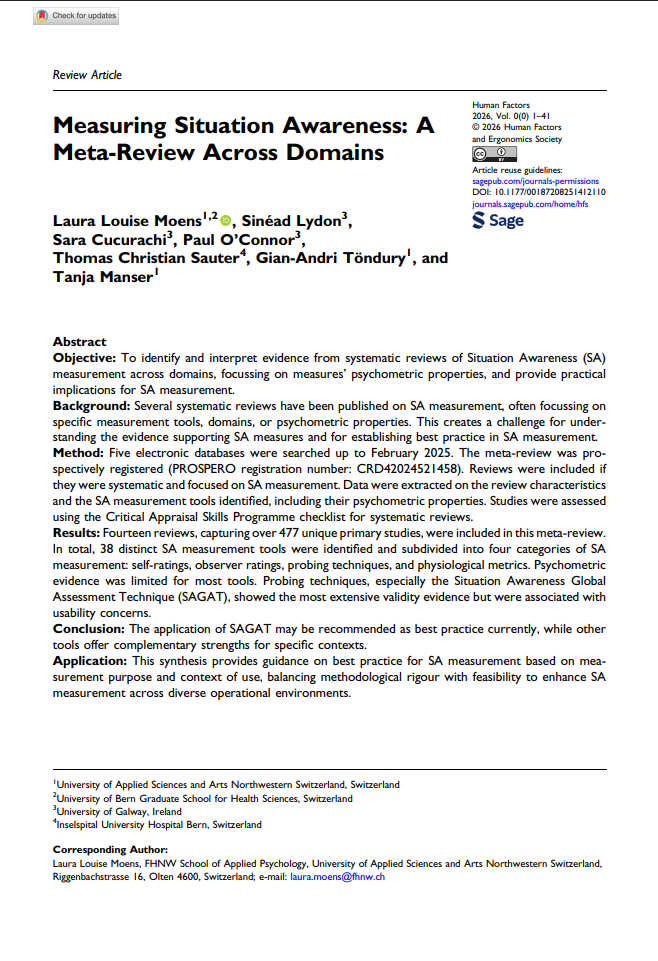
New Publication from Our Network: A Meta-Review on Measuring Situation Awareness (Moens et al., 2025)
Situation awareness (SA) is a critical factor for safe and effective performance in complex socio-technical systems, yet its measurement remains challenging. This meta-review synthesises findings from 14 systematic reviews published across a range of domains, such as healthcare, aviation, driving, sports, and cybersecurity. Together, these reviews encompassed more than 450 primary studies and identified 38 distinct SA measurement tools.
The tools were classified into four categories: self-ratings, observer ratings, probing techniques, and physiological metrics. The review synthesises available evidence on the validity, reliability, and usability of these approaches and identifies important research gaps where psychometric support or practical feasibility evidence remains limited. In addition, the findings highlight how different measurement approaches reflect distinct perspectives on SA.
Overall, the review illustrates that no single method is universally optimal. Instead, the review offers evidence-informed guidance to support the selection of SA measurement approaches based on application purpose, context of use, and practical constraints.
Authors: Laura Louise Moens, Sinead Lydon, Sara Cucurachi, Paul O’Connor, Thomas Christian Sauter, Gian-Andri Tondury, and Tanja Manser
New Publication from Our Network: Characteristics of person-centred practice in the stroke patient trajectory: a scoping review (Sabri et al., 2025)
We are pleased to share our newly published article entitled “Characteristics of person‑centred practice in the stroke patient trajectory: a scoping review.” This study was published in BMC Neurology and explores how person‑centred practice is understood and implemented during the first three months following stroke onset.
Based on a comprehensive scoping review of 96 studies from diverse healthcare contexts, the article highlights that the literature predominantly focuses on shared decision‑making, holistic care, and information provision. Facilitators and barriers to person‑centred practice were mapped across five key areas: care environment and organisation, communication and shared decision‑making, patient participation, interprofessional practice, and caregivers as partners in care.
Despite growing attention to person‑centred approaches in stroke care, the review identifies important gaps. These include limited use of theoretical frameworks, a lack of well‑described implementation strategies, insufficient attention to outcomes, and a need for practical tools and digital solutions to better support person‑centred practice across the stroke patient trajectory. The findings underscore the complexity of implementing person‑centred care and point to clear directions for future research and practice development.
Authors: Asma Sabri, Karina Aase, and Sissel Iren Eikeland Husebø

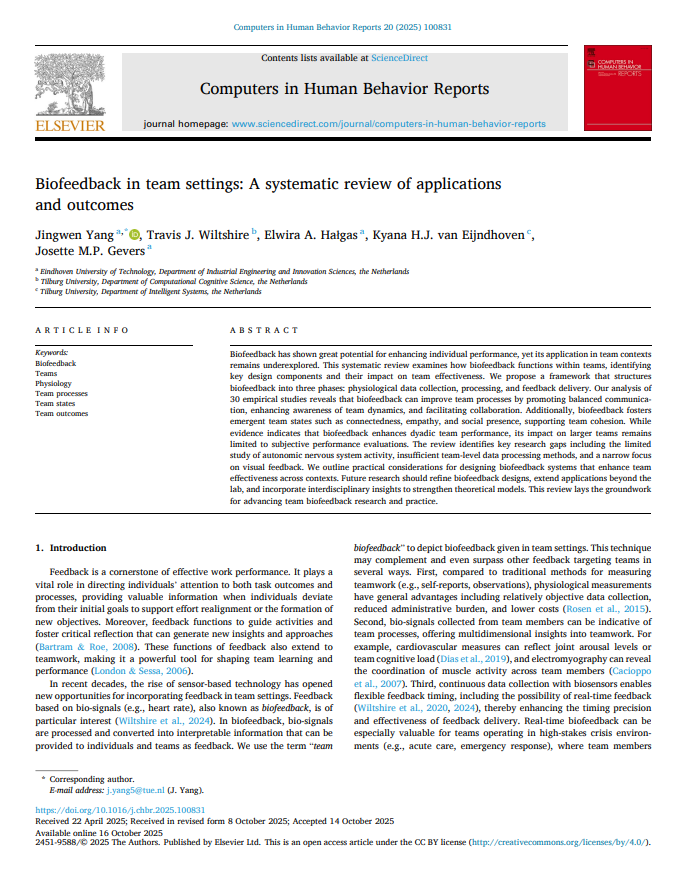
New Publication from Our Network: Biofeedback in team settings: A systematic review of applications and outcomes (Yang et al., 2025)
Biofeedback uses physiological signals to make people more aware of their internal states and improve performance. While it has been widely studied for individuals, its use in teams is still emerging. This review brings together findings from 30 studies to understand how biofeedback works in team settings and how it can enhance team effectiveness. We propose a simple framework with three stages: collecting physiological data, processing it, and delivering feedback to the team. The studies show that biofeedback can help teams communicate more evenly, stay aware of group dynamics, and work together more effectively. It also strengthens shared feelings such as connectedness, empathy, and social presence. However, most research focuses on pairs rather than larger teams and relies mainly on visual feedback. We highlight these gaps and suggest ways to design better biofeedback systems that support teamwork in real-world contexts, including healthcare simulation training.
Keywords: Biofeedback, Teams, Physiology, Team processes, Team states, Team outcomes
Authors: Jingwen Yang, Travis J. Wiltshire, Elwira A. Hałgas, Kyana H.J. van Eijndhoven, Josette M.P. Gevers
Journal: Computers in Human Behavior Reports
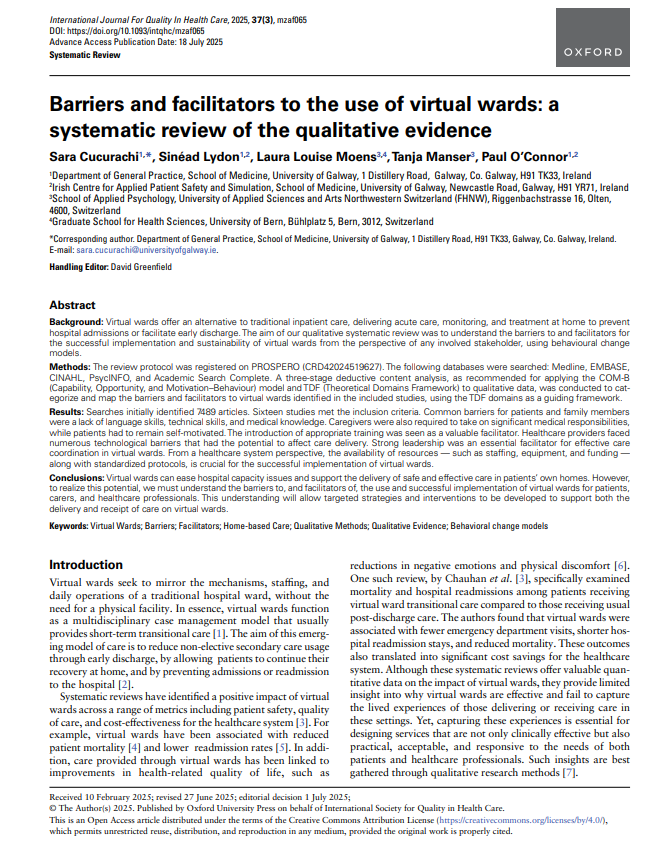
New Publication from Our Network: Barriers and facilitators to the use of virtual wards —a systematic review of the qualitative evidence (Cucurachi et al., 2025)
Journal: International Journal for Quality in Health Care (2025)
Link: Read the article
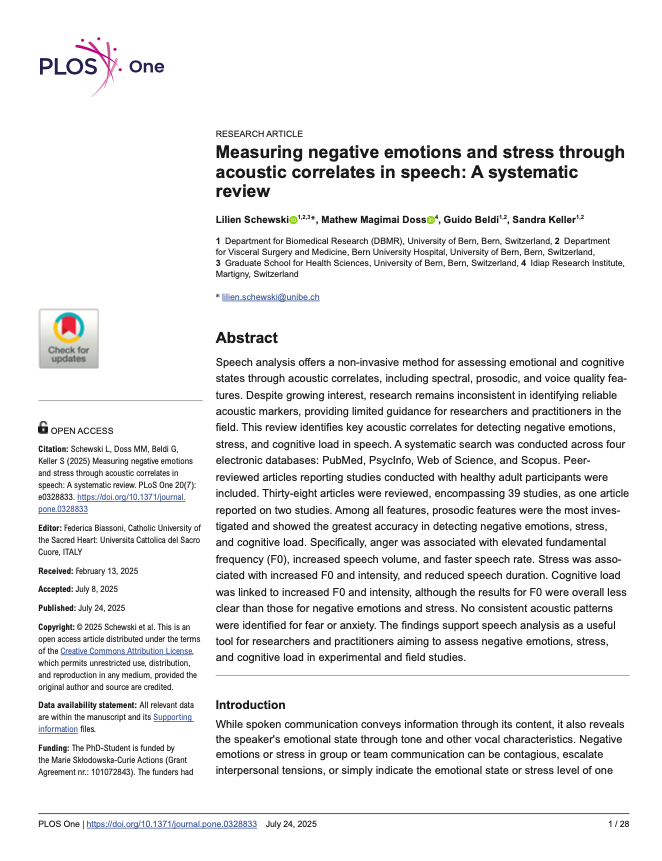
New Publication from Our Network: Measuring Negative Emotions and Stress Through Acoustic Correlates in Speech — A Systematic Review (Schewski et al., 2025)
Can our voices reveal how we feel under stress or emotional load?
This systematic review by our team at the University of Bern and the University Hospital of Bern explores how speech—specifically acoustic features like pitch, intensity, and speech rate —can serve as a non-invasive method to assess negative emotions, stress, and cognitive load.
Reviewing 38 articles across four major databases, we found that prosodic features (such as fundamental frequency) were the most informative for identifying negative emotions, stress, and cognitive load. Specifically, anger was associated with elevated fundamental frequency (F0), increased speech volume, and faster speech rate. Stress was associated with increased F0 and intensity, and reduced speech duration. Cognitive load was linked to increased F0 and intensity, although the results for F0 were overall less clear than those for negative emotions and stress. The evidence for emotions like fear and anxiety remains mixed, highlighting the need for more targeted research.
This work offers key insights for both researchers and practitioners interested in emotion recognition, affective computing, and stress monitoring in real-world settings.
Link to the full article, published in PLOS One: https://journals.plos.org/plosone/article?id=10.1371/journal.pone.0328833
New Publication by Tool4Teams PI’s on Behavioral sciences applied to acute care teams
Dear readers,
we would like to share a new article with the title “Behavioral sciences applied to acute care teams: a research agenda for the years ahead by European research network” published by members of the “Behavioral Sciences applied to Acute care teams and Surgery (BSAS) research network. This collaborative effort has defined knowledge gaps, setting the stage for a dynamic research agenda and the development of 12 DC positions.
Six key topics were identified, emphasizing interventions to improve team processes, dealing with and implementing new technologies, understanding and measuring team processes, organizational aspects impacting teamwork, training and health professions education, as well as organizational and safety culture. By identifying these critical knowledge gaps, the BSAS community advocates for targeted funding in these areas. Furthermore, 12 projects for doctoral candidates have been developed, with the aim to close the gaps in research and to enhance our understanding of teamwork in acute care and surgical settings.
If you want to know more about the doctoral candidates’ projects, click here.
Link to the article, published in BioMed Central (BMC):